
When I first started setting fitness goals and making changes to my lifestyle, I thought I could just ‘wing it’ and rely on motivation alone. Fortuantely, my motivation grew and kept me going for years. Then about 5 years ago, I got my first injury. Motivation started to waiver as I couldn’t move and do the same things that used to bring me joy. A decently bad injury to my foot, leg, and hip had me unable to even walk without crutches. A bad Acro yoga drop. It was going to be months of slow recovery and who knows how long until I got back to where I was, if ever.
Motivation wasn’t going to get the job done. Fortunately in that time, I had also built dedication. Dedication wins over motivation every time. How was I going to get out of the depression and back to a place where my movement practice brought me happiness and enabled me to do the things that nourish my soul again, like hiking and rock climbing and yoga? Setting goals and tracking progress.
I started journaling and I’m so glad that I did, because without tracking my progress, my goals felt too abstract and distant. There’s something about seeing the results, no matter how small, that kept me going. I hurt less than the week before. I was able to walk farther.
Tracking isn’t just about checking off boxes—it’s about gaining insight into what’s working, what needs adjustment, and most importantly, recognizing the hard work that’s paying off. And I continue to track my goals and progress years later.
Now, I am selling a Dry January Reset guide and I would love for you to check it out! It includes a space for tracking, journaling, and workout tips and ideas. But you don’t need to buy anything to track your goals and don’t worry, this entire article isn’t an ad. 😉
Here’s why I believe tracking your progress is key to reaching your goals.
1. It Keeps You Accountable
Accountability is a game-changer. I used to think that if I just “knew” I wanted to go alcohol-free for a month or commit to my workouts or work on a skill, I would follow through. But it wasn’t until I started tracking my actions, for example logging every set and weight of a workout, that I truly began to see my dedication reflected back at me. It’s like having a personal reminder that you’ve committed to something, and when you can physically see the consistency, you feel more driven to stick with it.
2. It Highlights Small Wins
Sometimes, we focus so much on the “big picture” that we miss all the little wins that add up. Early in my journey, I realized that tracking helped me celebrate even the smallest victories. Like when I noticed that I was lifting heavier weights at the gym or getting deeper into a backbend. Every time I logged that progress, it made me feel like I was actually achieving something, and that motivated me to keep pushing.
3. It Provides Clarity and Focus
There have been many times when I felt like I was spinning my wheels, unsure if what I was doing was even working. Tracking my progress helped me zoom out and see the bigger picture. When I review my journal or app, I can pinpoint the things that were moving me forward and the things that weren’t working so well. For example, when I started tracking my gym workouts, I realized I wasn’t progressing as much with my strength training as I thought—until I looked at my logs and saw that I wasn’t pushing myself enough with progressive overload. Once I started increasing my weights week by week, my strength improved noticeably.
4. It Reinforces Positive Behavior
I’ve always found that when I see my progress written down, I’m more likely to stick with it. When I hit a milestone, like completing a week of workouts without skipping one, I feel so proud of myself. Tracking provides that immediate feedback that makes me feel good about the efforts I’m putting in. Whether it’s my mindful eating habits or hitting a personal best in the gym, seeing progress on paper makes it real, and it keeps me going.
5. It Creates Momentum
I can’t tell you how much momentum I’ve gained simply by tracking my daily actions. There’s something incredibly motivating about watching those points add up. It’s like a snowball effect—I want to keep going and see how far I can take it. For example, doing a lot of “junk volume” in the gym.
6. It Helps You Reflect and Adjust
The beauty of tracking is that it isn’t static. I’ve learned so much from reviewing my own logs, especially when things weren’t going as planned. For example, during the first week of a fitness challenge, I noticed my energy levels dipping. Upon reflecting on my food log, I realized I wasn’t getting enough protein to support my workouts. I adjusted, and my energy came back—along with the realization that getting enough protein sometimes feels like a full-time job. But that’s a story for another day. 😂Tracking helps you spot patterns, make changes, and get back on track when you need to.
Practical Applications for Dry January:
Tracking Your Dry January Journey
In the Dry part of our challenge, tracking might look like journaling. Writing down when and why you feel like you want to drink alcohol. Is it harder to stay strong at a social gathering where you feel out of place without a drink in your hand? Maybe you always have a cerveza with tacos and getting a nonalcoholic beer would help!
Tracking Your Gym Progress with Progressive Overload
If you’re unfamiliar with the term, progressive overload is about gradually increasing the intensity of your workouts to keep challenging your muscles. Interestingly, I found that I was pushing myself too much too fast in the gym at first. I had been influenced by social media to push to failure on every workout, but I wasn’t making the progress I expected. When I recorded myself, I saw my knees wobbling on squats, and realized I wasn’t focusing enough on form. I set my ego aside and worked on form. Then the strength gains followed as I was able to sustainably add weight in a progressive overload.
Tracking Your Yoga and Mindfulness
Tracking yoga does not have to mean looking for a more “advanced” physical asana practice. For example, when I first started yoga, my focus was solely on getting the poses “right.” now I find that keeping a regular practice helps me to feel physically better in day-to-day activities and more able to breathe through life’s stresses. Tracking your mindfulness journey can involve noting moments when you felt particularly centered during your practice or even throughout the day. Did you notice a shift in how you reacted to stress or how you felt after a meditation session? Are you practicing mindful breathing when things feel chaotic, or taking more intentional breaks during the day? Recognizing these moments, no matter how small, can deepen your connection to the practice and give you a tangible reason to continue.
Don’t underestimate the power of tracking! It’s not just about keeping tabs—it’s about giving yourself the best shot at success. I’ve seen how tracking helps me stay focused, dedicated, and constantly moving toward my goals, and I can’t wait to see how it works for you too. So grab your journal or app, and let’s make this journey one you’ll be proud to look back on!
If you’d like to support me, I have released a 40 page Dry January Reset guide which has tracking space and journaling prompts along with ideas for building your workout, cardio, and yoga practices. It is $5.50 on buy me a coffee! Check out the tracking page for week one. 👇
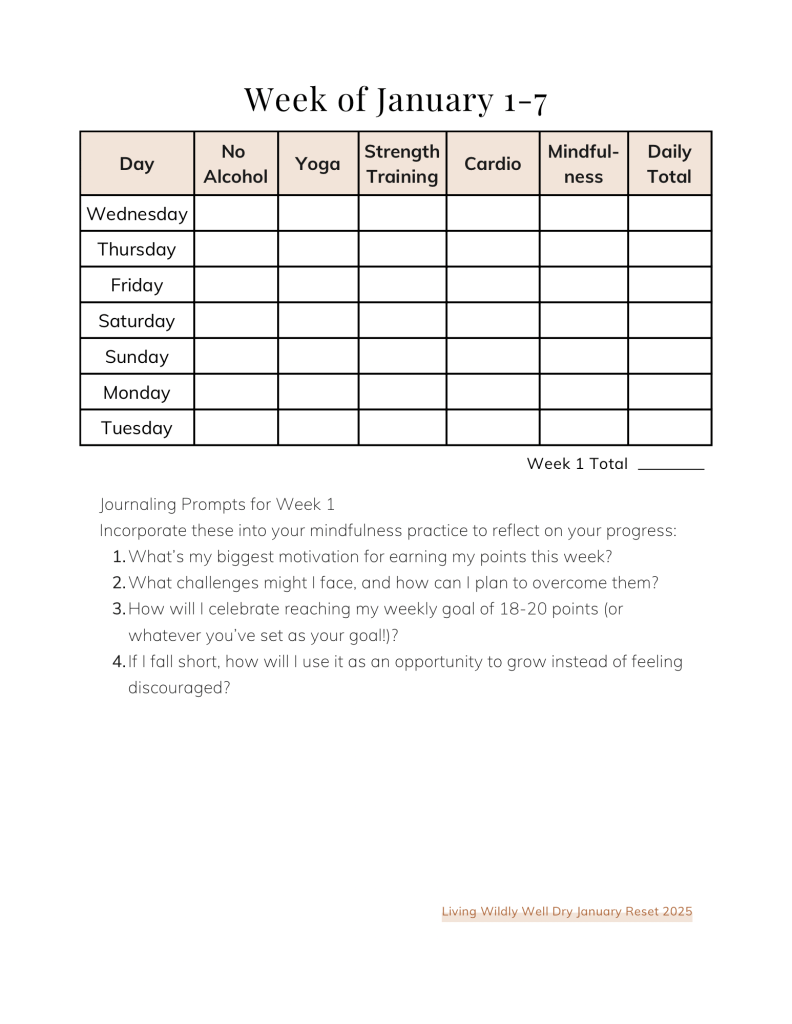
Do you track your goals? What do you use? ✍️







 Living Wildly Well