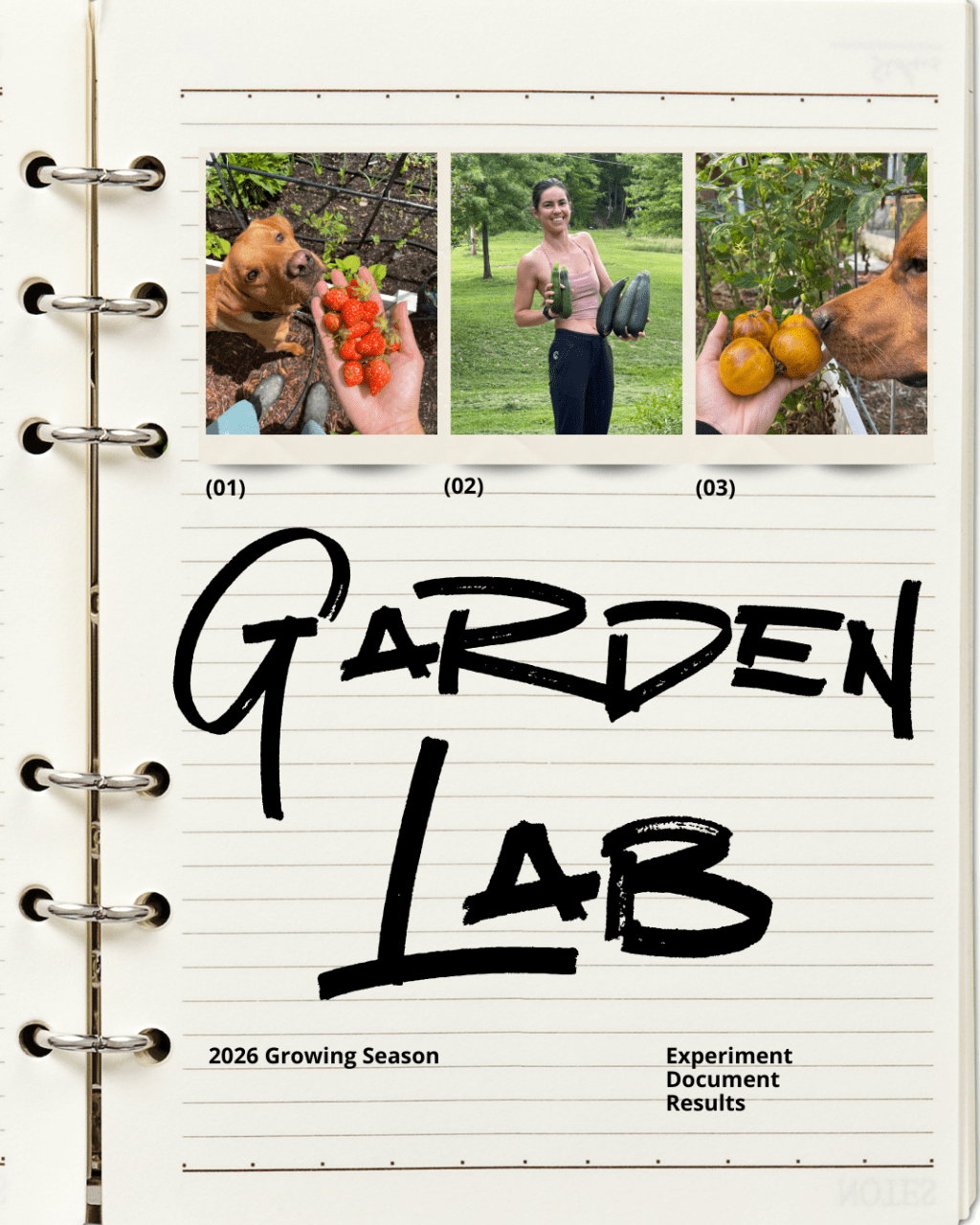
Maybe I’m a little weird. *okay, I know I am* But I’ve always thought about my garden as a science lab, my own n=1 experiment where every seed, sprout, and harvest is data.
I mentioned in my last garden post that one year I weighed and calculated the cost savings of growing my own. You may not be surprised that this was not the only scientific tracking that I’ve done.
I’ve tracked everything from cost savings, to yields, to the success (or heartbreak) of specific varieties.
Why does tracking matter? It comes down to your goals. If your goal is to build a garden to generate content, your garden will look and function very differently than one that is built to feed your family.
My goal is to feed my family. Remi particularly loves zucchini from my cutting board. And picking (stealing) strawberries, peas, and beans straight from the garden. And I’ve been pretty successful in that goal. Last year I didn’t buy much in the way of fresh fruits and vegetables from the grocery store from June-October. This did mean that I got a little sick of beans and zucchini, but I digress!
I also put away six larger zucchini rampicante for storage, a few pints of soup, lots of bags of beans, tomatoes, and squash, and a few containers of salsa. Oh, and I saved seeds and about a cup of cowpeas that I need to cook before the 2026 ones are ready!
That may not sound like much to you, but those successes taught me two important lessons. One, I’ve found the scale of gardening that is productive for my family and my wallet. And two, dialing in the correct varieties, timing, and spacing matters. That brings me to this year’s experiments.
2026 Seed Experiments
Starting from seed is stupidly less expensive than buying grown plants from the store. $12 for a tomato? No thanks. $3 for a head of romaine? You’re out of your mind! (also, just buy a full head of lettuce, celery, and green onions, chop off the bottom, and stick them root side down in some water for a few days before transferring to the garden. They will regrow!)
So this year, honestly, as usual, I bought more seeds than I need. I will admit, it is my biggest money waste in the garden. I buy more seeds than I can grow because the hobby part of gardening for me is experimenting with new varieties.
Seed cost 2026 $82. (This does not count flower seeds, those I categorize as decorative gardening and do not factor in the dollars spent or saved on food.)
Yes, I spent $50 on seeds. These are all new to me varieties and the heart of my garden experiments this year. I’ve got enough onion seeds to last me and my entire neighborhood for the next three years. But if it pans out like I’m hoping, I’ll break even this year and every subsequent season using these seeds will be pure profit. So to speak.
I have two new varieties of squash that I’m very excited about. Block Party Butternut Squash and Marmalade Kabocha Squash. Both are said to be very productive and store well. Last year I tried to grow a variety called Mariana di Chioggia. I grew two terrific vines. Even had a few flowers. And two failed fruit! Hence, the search for a better variety continues. Zucchini Rampicante was the breakout star of the garden last year and more than made up for her unproductive cousin. I harvested some that we ate as fresh summer squash until we were sick of it, and as I mentioned, stored some away for later.
$30 for garlic, planted in October. This is the easiest calculation. Near me, conventional garlic can be found from 80 cents to organic at $1/head. Let’s take the easy calculation since I’m growing organic. My $30 seed garlic got me 50 good cloves for planting and a few that I ate. If they all survive, I’m already $20 ahead for the year. Additional costs include worm castings to feed the garlic- already had on hand, and compost, homemade, $0. There will be a YouTube video of the entire process once I harvest, so stay tuned!
The Experiment Parameters
Okay, that is a bit of a push of a title to make it fit the lab theme. Humor me.
I have a month by month guide for what seeds to start and restart. This works for me. For my growing zone. For the pots that I have to work with, and with the amount of grow lights necessary until I can transplant outside. You will need to tweak this to your specific needs.
I can’t recommend enough the farmer’s almanac for checking your planting and seed starting times. In the US, it is a free resource and highly individualized to your specific zipcode. If anyone abroad is reading this and knows of something similar for your area, please drop it in the comments and I’ll be happy to share!
Predictions
I predict this to be my best year ever. Specifically because ever year is my best year ever. Even the years that are not the most productive teach me so much. And what I have a hard time expressing here is how much joy and peace spending time in the garden brings me.
If you aren’t subscribed, be sure to do so to follow along with year’s harvests!





 Living Wildly Well