TL;DR: RICE is outdated! I’ve been using the PEACE & LOVE protocol to heal my hamstring smarter and faster. Protect, Educate, Load, and move with optimism—it’s all about gentle progression and trusting your body’s natural healing process. 💪
If you exercise, or heck, if you move at all, you’ve probably suffered from an injury at some point in your life. Growing up, I was plagued with ankle twists doing my “gymnastics” (in quotes because I wasn’t actually ever in gymnastics) on the playground. As an adult my physical therapist confirmed that I have some amount of hypermobility in some of my joints. In fact, a lot of people who are involved in yoga do. It’s what makes some of them instantly “good” at stretchy and bendy poses. Gosh I wish mine worked that way but mine seems to be limited to the collagen disorder and skipped out on the effortless drop into splits. 🤣(this is a joke, hyper-mobility causes lots of issues!)
ANYWHO… I digress. Let’s get back to RICE and PEACE and LOVE ☮️
Why RICE Is Outdated
If you’ve ever dealt with an injury, chances are you’ve heard the RICE protocol, which stands for Rest, Ice, Compression, and Elevation. For years, I followed it without question because, well, that’s what everyone did. But recently, I injured my hamstring (thank you, hypermobility). Now it wasn’t terrible. I’ve self diagnosed grade one out of three. Being the bottomless pit of curiosity that I am, and really hating both rest and ice, I had to see if the RICE protocol was still supported by the latest research.
Did you know that the creator of RICE no longer endorses it? 🤔
This got me digging into journals and studies, trying to find the best approaches to recovery, and what I found was a protocol called PEACE & LOVE. Not only does it feel more aligned with my body, but it’s helped me heal smarter and stay connected to my movement practice.
What I found is what makes intuitive sense to me.
What Is PEACE & LOVE? Here’s the New Healing Protocol
Protect Elevate Avoid (Anti-Inflammatories) Compress Educate & Load Optimism Vascularization Exercise
As you can see, there are still elements of RICE, but the key differences I found helped me to heal my hamstring injury are:
- Your body needs inflammation to heal—think of it as your body’s natural healing crew. When you get a soft tissue injury, inflammatory cells like macrophages rush to the area to eliminate damaged tissue and kickstart muscle regeneration.
- So where does ice fit in?
- Ice can be helpful in moderation during the early painful stage (like days 0-3). BUT overusing ice or anti-inflammatories can actually slow healing by interrupting this natural process. It’s like trying to put out a fire that’s meant to repair the damage. Let your body do its thing!
- Loading is something that if you’ve ever been to physical therapy, you will be familiar with. Starting out in pain free range of motion and load, gradually increase both in a controlled and intentional way. This can be where education comes into play.
- Exercise and vascularization once you get past the initial pain and inflammation. This means, for me, walking every day for longer and more frequent trips and things like leg swings. I also have been exercising everything that I can that isn’t directly taxing my hamstring. Planks and things using my upper body. There isn’t a need to stop exercising. Studies show that the people who keep moving have much quicker and better recoveries, coming back stronger than those who chose to wait out the injury.
- Optimism. This one cannot be emphasized enough. Your body listens to the voice in your head and your mind listens to the words you say. It sounds like something a peace and love hippie would say, but it’s true! (more on this in my next post!)
So what has recovery looked like for me in the first two weeks of my injury? My immediate steps for the first 3 days were PEACE. I protected by avoiding deep stretches, keeping my stride short. I didn’t have a lot of pain so I skipped anti-inflammatories altogether. I learned A LOT about my particular injury. I did a lot of investigation on different types of therapies available and their efficacy. I considered a few like hyperbaric oxygen therapy and then found out how extensive and expensive that was and put it in my back pocket for in case this doesn’t heal in a reasonable timeline!
Heat felt good to me after the first 72 hours, not directly on my injury at first, but a heating pad above or below seemed to help with the slight pain I had and kept it from tightening up while I was less active. After a few days, I started taking daily baths with lots of magnesium (Epsom salt) in them. The research seems to be split on if your can absorb magnesium into your body through your skin, but for me, I found this helpful for body and mind relaxation.
Having been to physical therapy before, I was familiar with the process of starting starting with very basic exercises and gradually adding weight, resistance, reps, complexity, and range of motion over the course of weeks. So I knew that if I wanted to heal this properly and as quickly as possible, I would need to skip weighted quats and deadlifts at the gym and my runs for a few weeks as I built back up.
Food as Medicine
Let’s talk food really quickly! You’ll hear me preach a few things that I practice over and over again. Mostly because what I see around me tells me that they aren’t on most people’s radar!
1. Low inflammation/anti-inflammatory food. This means the classics, foods high in omega 3s like salmon, high in vitamins like grass fed beef, high in antioxidants like berries, kiwi, and turmeric, and low in inflammation like easing way back or cutting alcohol and sugar.
2. Eating enough food. First hand observation is that a lot of women don’t eat enough food in an effort to stay thin. This messes up your metabolism and can can lead to ‘skinny fat’ syndrome. And it disrupts your hormones and inhibits your body’s ability to repair and grow. Repair takes energy! Food is energy. Don’t eat way less because you are moving less unless you are under supervision of a doctor who tells you otherwise.

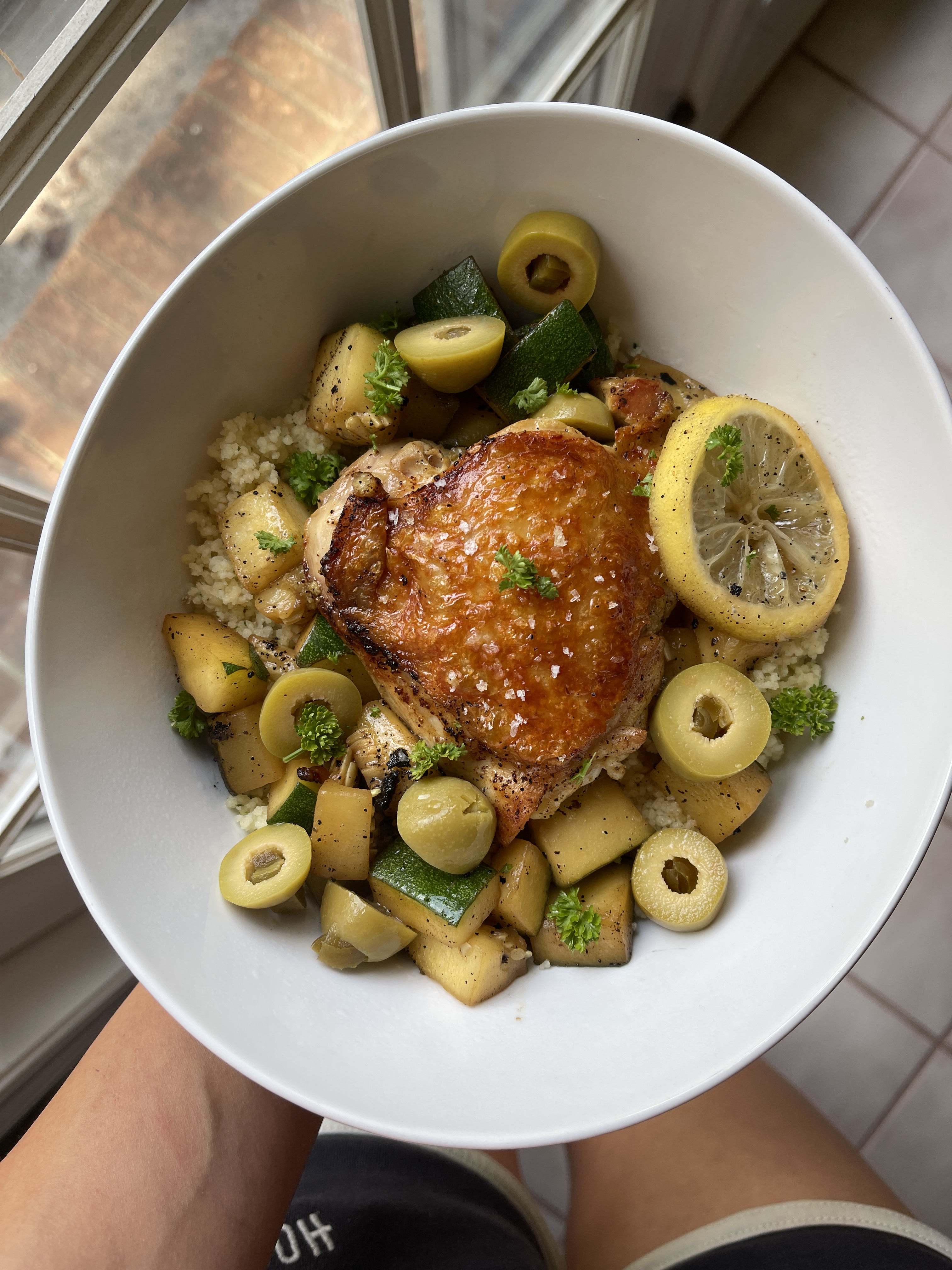
So here is what has worked for me so far. Keep in mind, this is just that, what worked for me, it is not advice. Everyone will be different depending on your injury. Don’t take risks with your recovery and consult with a medical professional when in doubt.
My Week-by-Week Recovery Timeline
Week 1: Rest and Gentle Movement
Day 0– the injury day. First, panic, denial, and depression. “How am I injured from a the same position that I had no problem with last week? AND I’ve been strengthening my hamstrings all summer.” *cries* Then the rational brain kicked in and I realized that this was probably a cumulative load injury. I am stronger and smarter than I was. I will heal and be back to the things I love soon. So let’s treat this. Three 20 minute rounds of cold right away and elevation to minimize swelling and pain. I avoided stretching and aggressive movement to prevent worsening the injury. Rest. Research. And the hardest part- not testing over and over. 🤪
Day 1-3– I was happy to see no bruising and pain level wasn’t much increased over the day before. This confirmed for me that it was only a level one and something I could handle on my own if I was careful. Focused on reducing inflammation and pain. Avoided direct pressure or massage on the hamstring. Used gentle range-of-motion (ROM) exercises like seated leg swings, heel slides, and very light walking around the house using a shortened gait to avoid pain and stretching/straining the hamstring. Low temp heating pad above and below the injury point to encourage circulation and relax the muscles. Added 20 minute daily Epsom salt baths to promote relaxation and circulation.
Days 4-7– Things were not feeling worse and so began the scary part, gentle stretches that avoided pain, such as butterfly pose and seated figure-four stretches. I was so nervous to test how much strain my muscles could take, so I was very careful, but success, I stayed within my limits and progressed ROM exercises and included controlled, mindful movements. Each day that passed, I was able to make my stride a little longer, getting to a normal size step without feeling any pulling or pain. Remi puppy was very glad for this as running around the yard alone is very boring.
Week 2: Early Strength and Light Activity
Days 8-14– This takes us into more familiar territory. Think PT basics. I incorporated basic strengthening exercises focused on proper form and keeping movements pain-free. Glute bridges that were in a small range of motion, standing hamstring slides with a towel on the floor (these were the worst), and side-lying leg lifts (for glute medius support).
I took a few 20 minute yoga classes online labeled beginner, morning, or gentle, modifying as needed, meaning no forward folds at the beginning of the week, and a generous knee bend in forward folds by the end of the week. All of this was in the pain free range.
I no longer felt the need for a heating pad or daily warm baths because the protective tightening was mostly all subsided. I have been able to use the massage gun on the surrounding muscles, the hamstring itself was a little too tender for a direct jolt quite yet!
I began taking longer walks with a normal stride length, even tackling the giant steep hill in my yard by the end of the week.
And the rest of my body is fine! So I’ve been working core and upper body, just staying mindful of protecting my hamstring while doing it.
Week 3 (Day 15 and Beyond): Controlled Strength Progression
This is where I am now. I am introducing progressive load while continuing to avoid high-impact or jerky movements. Plans are to increase reps for glute bridges and standing hamstring slides. I will be adding exercises like step-ups, bodyweight squats, and Romanian deadlifts with no weight, focusing on slow, controlled motion. Low-intensity Pilates and yoga practices to restore coordination and range of motion. Progress my light stretching in all planes, avoiding deep stretches that cause discomfort. I plan to see how very light rowing feels and I will go to the gym to hit the stationary bike very gently.
I am still avoiding impact exercises like jumping and running until at least next week as I see how I tolerate this added workload on my hamstring. That means I won’t be hitting my 5k by the end of this year, but I’m okay with that! The name of the game here is longevity!
Key Tips That Helped
- Mindfulness: Progress was guided by staying below the pain threshold. If something caused pain, I dialed it back and adapted.
- Patience: Each week had a clear focus, from rest to mobility to strength, building a strong foundation without rushing.
- Consistency: Daily engagement with gentle movement, self-care (Epsom baths, light massage), and monitoring progress kept the healing on track.
- Gradual Progression: Reintroduction of activity started with low reps/intensity and only scaled up when the body responded well.
So, what about you? If you’ve ever dealt with an injury, have you tried the PEACE & LOVE approach? Or were you team RICE like I used to be? Share your experiences or questions in the comments below—I’d love to hear how you heal smarter!
For further reading, check out this British Journal of Sports Medicine Article, which has lots of references linked.
Since Optimism is in the protocol, what have I been doing to keep my mind occupied and optimistic while I recover? 🤔 Stay tuned for my next post where I’ll share the activities, hobbies, and mindset tricks that have kept me feeling positive and productive during this healing process! Don’t forget to subscribe so you don’t miss it! 💌

 Living Wildly Well
Leave a reply to Staying Active, Optimistic, and Curious While I Heal 🌿✨ – Living Wildly Well Cancel reply